
38. Exemplary Salvation Experiences (Part VIII)
- Tom

- Jan 3
- 8 min read
Updated: Jan 10
The Legend Continues
We’ve learned about Philip the evangelist--the man, the deacon, the legend. His story is recorded for us in the Book of Acts. It is in that book that Philip, more than anything else, models for us the best method for evangelism--the Biblical method!

You and I can learn from Philip's method so that we might perform effective evangelism in our own ministries. Why is it so important to be effective in evangelism? Quite simply, so that we might produce what Jesus called fruit that will last (John 15:16). We do not press people towards emotional decisions, but towards an eternal covenant with God.
He Who Endures to the End
The problem with ineffective evangelism is that it does not give long-term results. In other words, it doesn't really save people from sin because people do not 'persevere to the end' to be saved.
... he who endures to the end shall be saved (Matthew 24:13; NKJV).
Perseverance and endurance matter with regard to salvation! They matter a lot. Without them, there is no salvation, and Jesus said so! Consider how the Lord Jesus explained two of the soils from his famous parable of the Sower. He explained the meaning of the rocky soil and he explained the meaning of the soil infested with weeds.
He said this:
Those on the rocky ground are the ones who receive the Word with joy when they hear it, but they have no root. They believe for a while, but in the time of testing they fall away.

The seed that fell among thorns stands for those who hear, but as they go on their way they are choked by life’s worries, riches and pleasures, and they do not mature (Luke 8:13-14).
Not True Jews
Acts describes how Philip evangelized the Samaritans—the people the Jews most despised. The Jews considered the Samaritans to be half-breeds. They weren't "true Jews" to the Israelis because the Samaritans had had intermarried with Assyrians during the Assyrian captivity.
The once-powerful region of Assyria is absorbed into the modern state of Iraq now. It covers a lot of the northern region where the city of Mosul still stands. You can visit the ruins of the Assyrian capital, Nineveh even today near the shores of the Tigris River in a state appropriately called "Nineveh Governorate."
You might remember from the Bible a few of the names of the Assyrian kings. Or, you might like history. But if you don't care much about ancient kings, then bear with us as we share the names of some famous Assyrian kings:
Tiglath-Pileser III
Shalmaneser V
Sargon II
Enjoy some images of the famous Sargon II:


Sennacherib
Esarhaddon
Ashurbanipal
Many of the Jews who were living in Northern Israel in 721 BC, when the Assyrians took hundreds of thousands of Jews captive, stayed behind. They dwelled in the land, and as a result of the Assyrian system of subjugation, they intermarried with Assyrians, becoming a new ethnicity. The other ten tribes of Jews who were taken to Assyria never returned.
They are often called "the Ten Lost Tribes of Israel."
The website Bible Hub sums up this sad period of Israel's history for us:
The Assyrian captivity marks the first major exile of the Israelites. The northern kingdom of Israel, comprising ten tribes, fell to the Assyrian Empire under King Shalmaneser V and his successor, Sargon II. This event is chronicled in 2 Kings 17:6: "In the ninth year of Hoshea, the king of Assyria captured Samaria and deported the Israelites to Assyria. He settled them in Halah, in Gozan on the Habor River, and in the towns of the Medes." The Assyrian captivity resulted in the dispersion of the ten tribes, often referred to as the "Lost Tribes of Israel." (Retrieved from the Topical Bible on 3 January 2026)


But the Samaritans changed much more than their DNA. They also altered the Jewish religion by "altering" the altar and establishing a new place of worship, not at the Temple in Jerusalem, but in Samaria. They also composed their own version of the Bible, established their own priests, and transformed what was a pure religion into a corrupt version of Judaism.
A True Jew
Most certainly, those actions were wrong, sinful, and evil. They could be compared to the Jehovah's Witnesses of today, or the Eastern Orthodox Church, or even the Mormons. They took a pure religion and distorted it just like these three groups have done.
Jesus knew that about the Samaritans. He knew their corrupt history and made no bones about it when he spoke with Samaritans. Our Lord Jesus directly confronted the wrongness of the Samaritan religion when he conversed at Jacob's Well with a Samaritan woman.
Here's part of the conversation:
'Sir,' the woman said, 'I can see that you are a prophet. Our ancestors worshiped on this mountain, but you Jews claim that the place where we must worship is in Jerusalem...'

'Woman,' Jesus replied, 'believe me, a time is coming when you will worship the Father neither on this mountain nor in Jerusalem. You Samaritans worship what you do not know; we worship what we do know, for salvation is from the Jews' (John 4:20-22).
With his crystal clarity on who was who, and his frankness in speech, you can imagine that Jesus wasn't the most beloved preacher among the Samaritans. In fact, they refused to receive him and to hear his message. Their reason was that our Lord Jesus was a true Jew. He had faith in the God of the Jews--the God whose Temple was in Jerusalem.
... he sent messengers on ahead, who went into a Samaritan village to get things ready for him; but the people there did not welcome him, because he was heading for Jerusalem (Luke 9:52-53).

Love Thy Neighbor
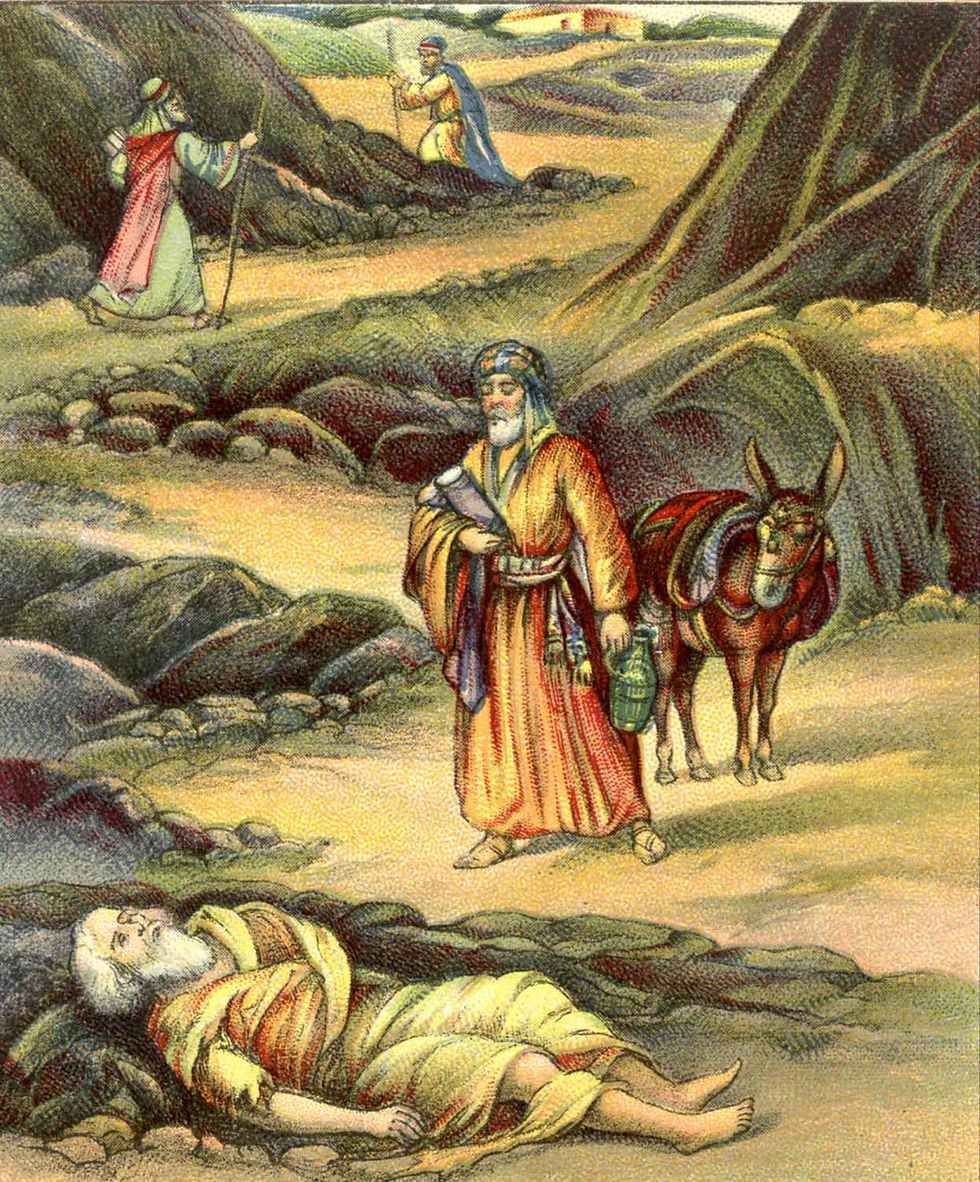
In spite of their rejection of Jesus, he still loved the Samaritans. He was merciful, as always. Our Lord taught his Jewish counterparts that in spite of the apostasy of the Samaritans, the Jews needed to see the Samaritans as human beings. He proved that the Samaritans were people too, and he proved it with a simple narration: the story of the Good Samaritan.
Through the Good Samaritan story, Jesus demonstrated that the Samaritans were perhaps even more capable of performing good deeds than the Jews themselves--and with a brilliant stroke of his storytelling skills, refused to allow the Jews to demonize the Samaritans.
Jesus taught his compatriots that the Samaritans were "neighbors" and deserving of their respect. He demonstrated that the Samaritans had human dignity, and Jesus confronted the Jewish as well as the Samaritan carnal tendency towards discrimination. That is, although Jesus confronted Samaritans with their religious sin, he could just as easily confront the Jews with theirs--and in both cases he would recognize the human dignity of both Jews and Samaritans.
Go Ye Therefore
Okay, but the Good Samaritan story is not the only time Jesus put the focus on the Samaritans in his teachings. Jesus also famously told the Apostles instants before his ascension to Heaven, that they needed to take his Gospel to the Samaritans!
That command, otherwise known as "the Great Commission," shook the worldview of Jesus' hearers to its core! If Jesus had given it in modern times, it would be like telling Jewish missionaries to go to Iran. Jews are very hated in Iran, and Iranians are very much hated by the Jews.
Other comparable missions would be: sending Ukrainians to Russia, or telling Taiwanese missionaries to go to China. Or, how about this comparison: An Evangelical Pentecostal family to Salt Lake City, Utah? Evangelicals do not gel well with the Mormons, and they shouldn't!
Or, how about this one: Send two members of our congregation to Moscow to evangelize Russian Orthodox believers? Or even better: You and your closest brother or sister in Christ go down the street, enter a Jehovah's Witness Kingdom Hall, and evangelize the whole group. Now, that's missionary work!

Now you know what it meant for Jesus to tell the Jews to to to the Samaritans. Now you know what it meant for the Jews to hear about loving the Samaritans. It was downright uncomfortable.

Patrick to the Irish
Speaking of discomfort, you may not know this, but the famous Patrick was not actually Irish. Rather, he was a British man who was kidnapped by Celts when he was a young man--and the Irish (who were the followers of the pagan Druid cult, worshipping stones and fire) enslaved poor Patrick in Ireland for six years.
Patrick's mission started when he returned to the Irish in 432 AD to evangelize them--and he didn't do it on a whim. Patrick received visions from God to do so. Jesus' statement 'You will be my witnesses... in Samaria' is that kind of revelation.

Our Lord's command was for his Apostles, twelve men who would have preferred to continue their simple life of fishing on the lake where they grew up, the Sea of Galilee, to do what they least desired to do. Do you comprehend the challenge?
Jesus told the Apostles, most of them simple fishermen:
... you will be my witnesses in Jerusalem, and in all Judea, and Samaria, and to the ends of the Earth (Acts 1:8).
No Jonah
To the ends of the Earth? Do we really need to go that far?
Well, yes. Do you remember when God told Jonah to go to Nineveh? That wasn't a skip around the block. It was far away. But what did the prophet Jonah do? He got on a boat and went in the opposite direction. That's the standard carnal reaction to the calling of God.

But Philip was no Jonah. God didn't need to send a whale to get him on track. Philip was well aware of Jesus' command to go to Samaria, and he was the first one to do it. He went joyfully to fulfill his Lord's command.
But it wasn't just robotic obedience that drove Philip. It was love. It looks like Philip must have heard Jesus’ Good Samaritan lessons too because he treated them like the "neighbors" Jesus said they were. Philip, beyond acting as an evangelist to the Samaritans, demonstrated a deep love for them.
Mission Complete
Inspired by the power of the Gospel, Philip went to Samaria, the most despised place for a devout Jew like himself. A place where Jews never passed. Although Jesus broke that tradition, conservative Jews like Philip would always choose to take the long, hot, desert road through the Jordan instead of passing through the small towns of Samaria. A man like Philip would go days out of their way to avoid passing through the mountains of Samaria.
Philip, a conservative Jew, broke the mold and traveled to the place his Jewish counterparts avoided like the plague. And there, in Samaria, with love, Philip preached Christ. He lifted up his voice on the streets and spoke about the Kingdom to the rivals of the Jews--the Samaritans. Remember: These were the infamous "half-breeds," the people Philip would have grown up considering his enemies.

The trip was a success! Philip evangelized thousands, and he was able to obtain very needed support from the Apostles Peter and John, who traveled from Jerusalem. Peter and John knew that they had to finish what Philip had started. They needed to provide the baptism of the Holy Spirit. So they laid hands on the people Philip had baptized.
And the mission was complete! Now, what about you? If you won't do it, then who will you support in fulfilling the Great Commission? You might not be a missionary, but you can support one.
Will we finish what Jesus, Philip, Peter, and John started? Will we go to our "Samarias," preach, baptize, and lay our hands on the people who (on a religious level) we were taught to despise? It's what the Lord Jesus wants.


Comments