
39. Exemplary Salvation Experiences (Part IX)
- Tom

- Jan 11
- 7 min read
The Ethiopian Eunuch
Did you know that Africa was ruled by queens more than 170 years before the birth of Christ? And African queens were in power well after Jesus' resurrection. Those queens were called Kandakes. They were famous as "king makers" and ruled in Cush, Nubia, and Ethiopia. Here's a bigger-than-life-sized ancient stone etching demonstrating the high regard these queens had in the Nile region of Africa at that time.

This particular artefact is currently in a museum in Berlin.
Well, a man who served an Ethiopian Kandake (English "Candace") was visiting Jerusalem to worship the One God, the God of the Jews. Returning from the journey, he had an encounter that would change his life forever. He met Philip the evangelist.
The man was a eunuch—in other words, he was castrated. No marriage for him. No children would ever inherit his wealth. No progeny would ever carry his name.
It was the policy of many ancient nations to castrate any man who would serve a queen. This, of course, guaranteed absolute integrity in the man’s dealings with his queen. It also guaranteed complete and utter allegiance to his job--in the case of the eunuch, his job was to act as treasurer of the Queen.

Well, this eunuch met the evangelist Philip on the road to Gaza and the Bible describes this man, the first African convert to Christ in all human history, this way:
... an Ethiopian eunuch, an important official in charge of all the treasury of the Kandake (which means “queen of the Ethiopians”) (Acts 8:27).
As treasurer to the queen, and as a eunuch, we're certain that the Ethiopian understood the meaning of a commitment. We deduce that a man who was willing to sacrifice a normal married life to do his job understood that a solid commitment to Jesus was what God demands of those who seek salvation.
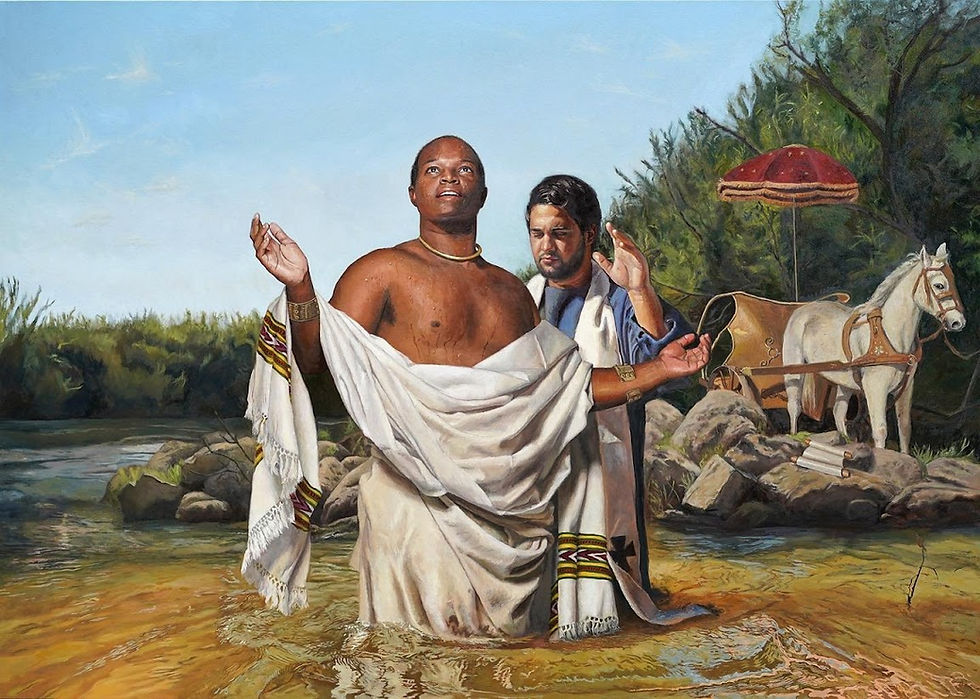
His grasp on the concept of commitment is why it wasn't hard for the eunuch to believe that baptism is a necessary for salvation. Consider how he responded to Philip’s preaching of the Gospel: The moment the eunuch beheld a pool of water on the road, he got excited and exclaimed: 'Here's water. What stops me from being baptized?'

Let's get the full picture and read the complete Biblical text here:
And Philip opened his mouth and beginning from this Scripture, he preached Jesus to him. And as they went along the road, they came to some water; and the eunuch said, ‘Look, water! What prevents me from being baptized?’
And Philip said, ‘If you believe with all your heart, you may.’ And he answered and said, ‘I believe that Jesus Christ is the Son of God.’ And he ordered the chariot to stop; and they both went down into the water, Philip as well as the eunuch; and he baptized him (Acts 8:35-38; NASB).
The Only Appropriate Response
This is an exemplary salvation experience, courtesy of Philip.
Baptism is the initiatory rite for entering the New Covenant. It's a believer's first step into commitment with God. There is no other way to enter the covenant our Lord Jesus established at Calvary, but through baptism by immersion. Not the so-called "prayer of faith"--but rather baptism in water is the only appropriate response to the Gospel.
God spent 1,500 years demonstrating to the Jews that obedience to the Old Covenant Law would not save them from sin. That's a major theme of the Old Testament--that another covenant was coming, one that would effectively save us from sin. The New Covenant, which begins with baptism, can save us from sin.
You cannot be justified by performing the works of the Old Testament Law. You don't save yourself, God saves you. You can't be "good enough." Only the Messiah is good enough, so we trust in his righteousness, not in ours. The New Testament books of Romans and Galatians, both authored by Paul, spill lots of ink on this theme.

There are a lot of studies you could buy about Romans and Galatians, but the best way to study them is to simply read the books themselves. Sit down and read the epistles straight through by yourself. Don't be afraid to tackle the Bible head on!

Judaizers Gone
Whether you read these books or not, history has resolved the issues they cover for us. The sect of Jewish legalists (their leaders were called the "Judaizers") has died off. The Early Church got freed from them. Although a small remnant of Judaizers exist today, they don't impact the Church the way they used to.
You may have heard about these modern-day Judaizers, or perhaps met some of them. They won't say "Jesus" but only use the name "Yeshua," and they celebrate only Jewish holidays. They eat kosher food and normally are strict sabbitarians (that means they rest on Saturdays).
Well, although they call themselves "Messianic" Christians--make no mistake about it--they are not Christians. They are heretical, dangerous, false teachers. And they always have been known as false teachers. They were the first heretical sect the Apostles had to fight with in the early days of the Church.
History has filtered these Judaizers out of the Church. Once Jesus came along, believers came to understood that salvation is by faith. Previously, the Jews obeyed God through commands written in stone. Now, all Christians obey God through faith in Jesus.
Salvation by Faith
We trust Jesus because God spoke from Heaven and said to us:

In other words, under the New Covenant, we obey God in a different way they did in the Old Covenant. We obey God through faith in Jesus. And obedience has become a lot easier because Jesus has written his commandments on our hearts with his Spirit. We don't receive God's commandments on tablets of stone anymore. We get them through his Spirit.
All people must now put their trust in Jesus, especially the Jews. Why especially the Jews? Because they are the only people group on Earth who have already been taught by God. If they had paid attention to the Old Covenant, they would have learned its big lesson: that we can't save ourselves! That was the main lesson of the Old Testament. Salvation is by faith.
Jesus in the Old Covenant
If anybody had paid close attention to the lessons of Genesis, Exodus, Leviticus, Numbers, Deuteronomy, and Judges, etc., they would have trusted in the Messiah now. He came as a Jew, after all! And God gave us signs, symbols, and metaphors of Jesus so many times in the Old Covenant.

Jesus was the "seed" of the first woman (Eve), the Angel of the LORD, the "seed" of Abraham, the Passover lamb, the High Priest, the rock in the desert, and the descendant of King David.
In addition, our Lord Jesus is greater than Solomon, greater than Elijah, and even greater than John the Baptist. Jesus is represented by Jonah, by Melchizedek, and by Adam himself. In fact, our Lord Jesus set aright what Adam set awry. He straightened what Adam made crooked.
Those who have now come to trust in Jesus discover what they sought when they lived under the Old Covenant: something that works. They discover a New Covenant that works.
The Covenant That Works
The New Covenant is not like the covenant given my Moses. It's not based on our unfinished works. It's based on Christ's finished work. Nobody will get salvation through "the covenant of works," but only through "the covenant that works." Being in the New Covenant is the solution to sin and death. It saves!

Baptism is an act of faith in Jesus. Baptism is what you do to appropriate Christ’s death for yourself--so it's an action, but it's no "good work." It's not a work of our own righteousness. Getting baptized is an act of faith, a commitment to enter the New Covenant.
Nobody gets baptized to act in their own power, but so that Christ will act in them through his power. They are seeking the power of the Holy Spirit. So, technically baptism is Christ's work, not ours. Jesus applies his payment of blood to our life the moment we are baptized, then gives us his Spirit. He does it all!
Getting baptized is not trusting in ourselves. It is trusting 100% in Jesus. In baptism we die. We renounce our strength, and we surrender our lives to the one who died for us.
When I get baptized, the old "me" is gone, and Christ begins to live within me. This is the experience of baptism! That's why the Bible says:
I have been crucified with Christ and I no longer live, but Christ lives in me (Galatians 2:20).

Made New
Only in baptism does Christ debit his payment for sins to our spiritual account. We are bankrupt, we are poor in spirit, but in baptism Jesus makes us rich. How so? Well, Jesus sends us his Spirit.
We who were lost become God’s redeemed. How does that happen? It happens because Jesus purchases us. Jesus pays God the price for our lives. That price is his blood—his life. With his blood Jesus covers our sins.
But there’s more. We enter the New Covenant in baptism. It's the beginning of a whole new life in peace and blessings. A covenant is a guarantee, so we get the guarantee of eternal life in baptism. The New Covenant has Jesus as its High Priest, so it's firm. It won't fail. It's worthy of your trust.

Identity
In baptism Christ becomes your new identity. When the baptismal candidate goes under the water, he is buried. When he rises from the water, he is resurrected. So his going down and coming up, baptism is full identification with the death, burial, and resurrection of Jesus Christ.
You can trace these truths through Paul's exposition of baptism in the Letter to the Colossians, below. In that letter, Paul calls baptism:
a circumcision performed without hands
the removal of the body of the flesh
the circumcision of Christ
burial with Christ

being raised with Christ
being made alive together with Jesus
the forgiveness of all our wrongdoings
the cancellation of our certificate of debt
the nailing of our certificate of debt to the Cross
dying with Christ, being raised with Christ
hiding your life with Christ in God
We'll wait till the next lesson to look at that passage of Scripture. Be ready to tune in again soon! In the meantime, consider how necessary it is for you to identify with Christ. He was not ashamed to identify with us as human beings. He took on the flesh, now it's time for you to take on the Spirit.

Jesus clothed himself with our humanity, now let's clothe ourselves with his divinity! We do this through baptism, just like the Ethiopian eunuch did.


Comments