
43. Exemplary Salvation Experiences (Part XIII)

Another Experience Led by Peter
We are the Church of the Living God. We are the Bride of Christ. As stewards of salvation, we oversee the new birth. So, evangelism is our specialty. Knowing this process well, we always procure the baptism in the Holy Spirit for a person who has just been baptized in water. Always.
In other words, we--God's evangelists--always make sure that the result of a person’s water baptism is baptism in the Holy Spirit. That’s because the two baptisms are inextricably linked. They go hand-in-hand like ying and yang.

The two baptisms are twins. They always go together. We don’t speak of one of the two baptisms in isolation. As the Church, we explain to people that the water and the Spirit baptisms are yoked together. They are tethered one to another.
Do you remember what Peter said in the one circumstance in the ministry of the Apostles when, very strangely, a man got the baptism of the Holy Spirit before he got baptism in water? Peter said:
‘Surely no one can refuse the water for these to be baptized, who have received the Holy Spirit just as we did, can he?’ And he ordered them to be baptized in the name of Jesus Christ (Acts 10:47-48; NASB).
In other words, Peter was certain that if the baptism of the Spirit had taken place, then baptism in water needed to be performed. He couldn't leave baptism in the Spirit alone. It had to be joined to water baptism.

This approach to salvation is remeniscient of what Jesus said to Nicodemus. You may recall that our Lord told Nicodemus, a leading Jewish teacher, that Nicodemus himself fell short of the requirements for salvation. Jesus reminded Nicodemus that Nicodemus needed two baptisms to enter into the Kingdom of God.
Here are Jesus' precise words:
Very truly I tell you, no one can enter the Kingdom of God unless they are born of water and the Spirit (John 3:5).

Baptisms is Plural
You’ll recall that among the Seven Foundations—that is, the Seven Fundamental Doctrines of Christianity are baptisms, plural! Note that the apostle does not write of “the doctrine of baptism”—which would make it singular. No. The author of Hebrews used a plural noun—and called this teaching the doctrine of baptisms--a teaching about baptism in water and baptism in the Spirit.
The doctrine of baptisms is a teaching about two baptisms. It’s a two-part teaching. It's the explanation of these two experiences and how they complement one another. Pastors and all teachers in the Church must master the topic and transmit the truth about how important they are for salvation.
Admittedly, the dual experience of baptisms can be complex, depending on each person's situation. Evangelism is more profound than simply saying to someone “be baptized.” We need to explain the process of new birth just as Jesus, Peter, and Paul did. Explanations and illustrations of dual baptisms abound in the Bible.

A Fundamental Doctrine
A good approach to these explanations is to demonstrate that dual-baptisms are the pattern of the New Testament. Dual baptisms are the pattern of the Apostles’ ministries in every single case of salvation in the New Testament. They always go together—baptism in water and in the Spirit.
This is why among the Seven Foundations, one is baptisms, plural. The author of the Book of Hebrews tells us of:
… the Foundation of:
1. repentance from dead works
2. and of faith toward God
3-4. of the doctrine of baptisms
5. of laying on of hands
6. of the Resurrection of the Dead
7. and of Eternal Judgment (Hebrews 6:1-2; NKJV).


Now, to sum up the doctrine of baptisms, you need to know this:
Baptism in water comes first, providing the forgiveness of sins, a good conscience, and entry into the New Covenant. Then, it should be immediately followed up with the baptism of the Holy Spirit. Missionaries, evangelists, and pastors administer this experience (call it a sacrament, if you like) by laying their hands on converts.
Flip Flop
That's the doctrine, but there is one exception. In one passage of the New Testament, the baptism of the Holy Spirit came prior to baptism in water. Although it happened just moments prior, and immediately after it came, the pastors who supervised the event had the converts baptized in water, the baptism of the Holy Spirit still happened prior to a man's baptism in water.
So, here’s the big question: Why did it happen that way? Well, there was a good reason.

First, let’s remember that although the two baptisms were still coupled together as a pair—that is, although they were complementary events—the order of the two baptisms was inverted. Every other example of baptisms in the New Testament puts baptism in water first, and baptism in the Spirit second, except for this solitary case.
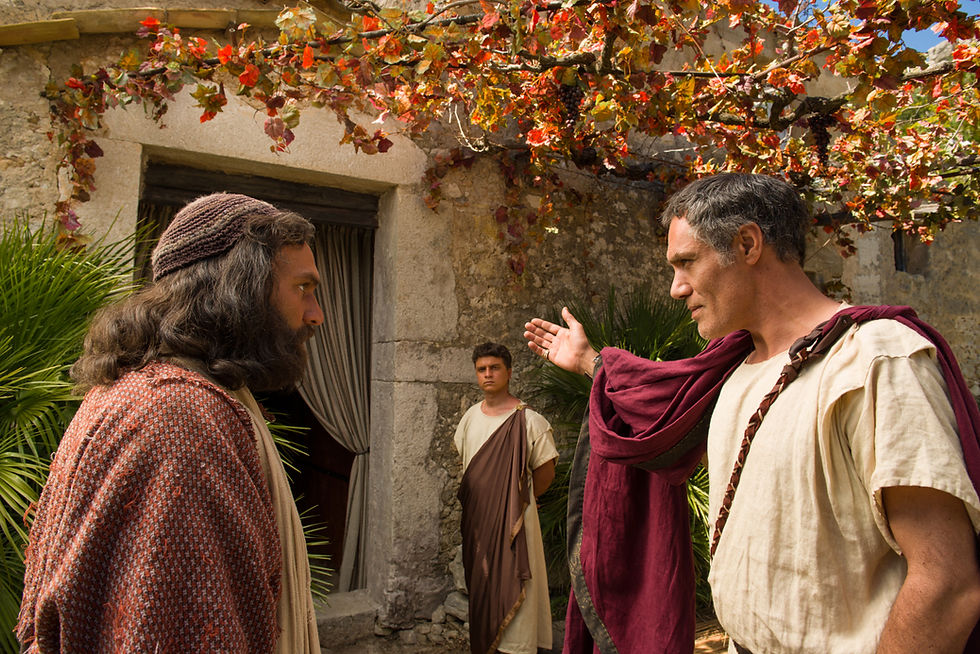
So, why the flip flop? Well, let’s take a look at this particular and singular case. You’re familiar with it already. It’s the conversion of Cornelius, the Roman centurion and the first Gentile convert to Christianity in history.
Cornelius’ baptism is the one time in the Bible where the order of water-Spirit baptisms was inverted to a Spirit-water baptism. It’s a peculiar case, and it happened at a pivotal juncture in Christian history. Cornelius' baptism was a crossroads for Christianity, so we need to look at it.
Spirit Before Water?
The baptism of the Holy Spirit came prior to water baptism to a Roman centurion named Cornelius, and it happened for a very good reason. Let’s look at 1) the social context. Then, let’s look at 2) the historical setting, and at 3) the religious events that were taking place.
1) The Social Context
Socially, Jews didn’t mix with Gentiles. That wasn’t a one-way street. Neither did Gentiles mix with Jews. There existed an invisible social barrier between the two, a social barrier that God Himself established when he ordered the Jews to eat foods which Gentiles commonly ate, making sure that there would be no fellowship between the two.
In addition, God also gave the Jews special holidays and dress codes. Those things caused them to stand out among the different ethnic groups of the World. God wanted them to be set apart—that is, he wanted them to be a holy people. He said this:
For you are a holy people to the LORD your God; the LORD your God has chosen you to be a people for himself, a special treasure above all the peoples on the face of the Earth (Deuteronomy 7:6; also 14:2 and 26:18).

He also said:
Now therefore, if you will indeed obey my voice and keep my covenant, then you shall be a special treasure to me above all people; for all the earth is mine. And you shall be to me a kingdom of priests and a holy nation (Exodus 19:5-6).
2) Historical Setting
God said those things, but then a new era in human history arrived, a new epoch. The Time of the Gentiles started on the day Peter entered Cornelius’ house. So, the Time of the Gentiles began there at Cornelius’ house, and it has lasted for 2,000 years.
Cornelius opened the doors of his house to Peter, received the Gospel, and history changed dramatically. History pivoted in the port town of Caesarea just a few years after Jesus’ resurrection! How so? Well, from that day to today, God shifted his focus from his covenant with the Jews, the one that he established through Moses, to his covenant with the Gentiles, the one he established through Jesus.

3) Religious Context
And what about religion? Well, at the Church’s inception, the religious fabric of the Church was entirely Jewish. The Church only consisted of Jews at the time Cornelius and his kin heard the Gospel. There were no Gentiles among the Church members.
The leaders of the Church--and Peter was the one Jesus chose to be the Lead Pastor--had not yet come to understand that Gentiles could join God’s Church. But then God sent Peter to a Gentile’s home in Caesarea, and he commanded Peter to eat with those Gentiles. That was something Peter had never done before, but it was then that Peter preached the Gospel to a Gentile family.

As you can guess, since God commanded that it should be done, something extraordinary happened. Here’s what the Bible tells us:
While Peter was still speaking these words [the Gospel], the Holy Spirit fell upon all those who were listening to the message. And all the circumcised believers who had come with Peter were amazed, because the gift of the Holy Spirit had been poured out upon the Gentiles also. For they were hearing them speaking with tongues and exalting God.
Then Peter answered, ‘Surely, no one can refuse the water for these to be baptized who have received the Holy Spirit just as we did, can he?’ And he ordered them to be baptized in the name of Jesus Christ. Then they asked him to stay on for a few days (Acts 10:44-48; NASB).

In spite of the blind spot Peter and the Apostles had, the Age of the Gentiles arrived! God was prepared to graft the Gentiles into his Church with or without the approval of the Church’s leaders—men who were all Jewish. God would override their discrimination against the Gentiles by granting the baptism of the Spirit to the Gentiles.
In other words, God gave the Gentiles the Holy Spirit without the Apostles’ approval. He gave his Spirit to the Gentiles without no approval from the Jews. Rather, with it, he reproved the Jews.
God Overrides Error
So, without waiting for the Apostles to baptize Gentiles in water, God sent his Holy Spirit to the Gentiles. God was compelled to do so because he wanted to save the Gentiles and the Jewish leaders of the Church did not know that it had to happen. The Apostles had not yet come to understand that the New Covenant had opened to the Gentiles.

Gently correcting the error of the Church’s Jewish leaders, God obligated them to accept the Gentiles into fellowship by giving the Gentiles the long-awaited seal of salvation: the baptism of the Holy Spirit. Cornelius became the first Gentile allowed into a community of Jews without converting to Judaism. He was the first to become part of the Jewish fellowship without any commitment to Moses.
After Cornelius’ conversion, a new standard was established. Gentiles didn’t need to become Jews to enter God’s Covenant. All this because God overrode the discrimination of Peter and the Jewish leaders of the Church. God overrode Peter by sending the Holy Spirit to Cornelius.
Led by God
So, although we’ve named our post “Experiences Led by Peter,” it’s a misnomer. The name should actually be “Experiences Led by God” since Peter only participated in Cornelius’ new birth—he did not lead it!

Eventually though, Peter did follow God’s leading. He began to baptize Gentiles who had repented and trusted in Jesus. He conformed to God’s new plan. Listen to the way Peter explained to the Jewish leaders in Jerusalem how God opened the door to the Gentiles through him:
Peter stood up and said to them, ‘Brothers, you know that in the early days God made a choice among you, that by my mouth the Gentiles would hear the word of the Gospel and believe. And God, who knows the heart, testified to them giving them the Holy Spirit, just as he also did to us; and he made no distinction between us and them…’ (Acts 15:7-9; NASB)


Comments