
56. Polycarp on the Trinity (Part I)

Updated: 12 minutes ago
Another Church Father Who Knew God
"Away with the atheists!" Polycarp cried, standing unconsumed amid the roaring pyre until the executioner’s blade sealed his eighty-six years of faithful witness.
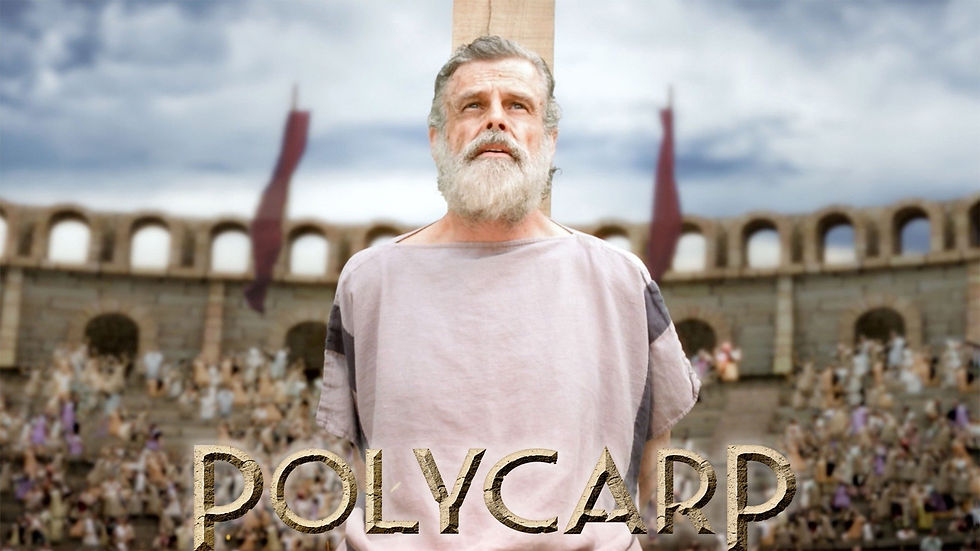
Polycarp (c. 69–155) was bishop of Smyrna in Asia Minor and a disciple of the Apostle John. He is one of the most important links between the generation of the Apostles and the second-century church because he knew not only the Apostle John and Ignatius prior to him, but Irenaeus who rose in the Church after him.
Although he had an impressive list of friendships, still Polycarp’s greatest quality was that he knew God. And that’s what we’re about to see today by examining verses from the one authentic letter he wrote: his Letter to the Philippians. But we also have a detailed eye-witness account of his martyrdom, which notably preserves his final prayer. Both documents manifest an orthodox theology and adherence to the four truths of the Trinity.
Of these four principles of Trinitarianism, the first is indispensable. It states that the Father is the One God. We invite you to see how Polycarp defended it. Then, decide whether you affirm it too.

The Father, the One True God
Polycarp’s swan song was a prayer in which he called the Father “the undeceiving and True God.” Complemented by a simultaneous acknowledgement of Jesus and the Holy Spirit, Polycarp honored the Father as the One God while recognizing the unity of the Three.
Listen to his statement:
You who are the undeceiving and True God. Wherefore also I praise You for all things, I bless you, I glorify you, along with the everlasting and heavenly Jesus Christ, your beloved Son, with whom, to you, and the Holy Spirit, be glory both now and to all coming ages. Amen (Martyrdom of Polycarp 14:3).
So, Polycarp honored the Father as the One True God. But Polycarp didn’t invent the theology of the Trinity. His submission to the Scriptures is what makes Polycarp a Church father. Along with Clement and Ignatius, whom we’ve already studied, Polycarp was essentially a Biblical man.

The Biblical Proof of Monotheism
Take a moment to reflect on the Church’s custom of acknowledging the Father as the One True God. This essential Christian belief is established by John and Paul in these two passages:
And we know that the Son of God has come, and has given us understanding so that we may know Him who is True; and we are in Him who is True, in His Son Jesus Christ. This is the True God and eternal life (1 John 5:20).
You turned to the [One] God from idols to serve the Living and True God (1 Thessalonians 1:9).
Monotheistic belief in the “True God” is not just from the Apostles, of course. Jesus Himself promoted it. Let’s recall that the Lord, in prayer to the Father, spoke these words:
And this is eternal life, that they may know You, the only True God, and Jesus Christ whom You have sent (John 17:3).

In His Own Words
Now, let’s return to Polycarp’s profession of faith in this “True God,” and as you hear it, notice how apostolic he sounded. Notice how he spoke the way Jesus spoke.
Polycarp’s last prayer sounded very Trinitarian, as he addressed the Father, saying:
I bless You because you have considered me worthy of this day and hour, so that I might receive a place among the number of the martyrs in the cup of Your Christ, to the resurrection to eternal life, both of soul and body, in the incorruptibility of the Holy Spirit…
Then, Polycarp went on to say what we just examined a minute ago:
You who are the undeceiving and True God. Wherefore also I praise You for all things, I bless you, I glorify you, along with the everlasting and heavenly Jesus Christ, your beloved Son, with whom, to you, and the Holy Spirit, be glory both now and to all coming ages. Amen (Martyrdom of Polycarp 14:2-3).

The Term “God Almighty”
Acting as Polycarp’s epitaph, those words prove the orthodoxy of his Trinitarian faith. But he said much more about the Father being the One God. For example, Polycarp distinguishes God as the Father from Jesus Christ by using the term “God Almighty” for the Father. You can see it in the opening of his Epistle to the Philippians, where he wrote:
Mercy and peace be multiplied to you from God Almighty and Jesus Christ our Savior.
You may recall that there are 48 occurrences of “God Almighty” in the Old Testament. We saw that when we looked at Ignatius’ use of the term in One God lesson 54. In that lesson, we indicated that the first time “God Almighty” was used for the Father was in Genesis 14:18-19.
Here it is:
And Melchizedek king of Salem brought out bread and wine; now he was a priest of God Most High also. He blessed him and said, 'Blessed be Abram of God Most High, Possessor of Heaven and Earth.'

We pointed out that the Church father Ignatius also used the term in his greeting to the Church at Rome, saying:
…the Church… which has obtained mercy through the majesty of the Most High Father and of Jesus Christ his only Son…
Polycarp’s “Almighty God”
Well, Polycarp at his death also used the term “the Almighty God and Father.” Now, his use of the term in the mid-second century gives credence to the antiquity of monotheism in Christianity: our affirmation that the Father is the One God.
Here’s what the witnesses of Polycarp’s martyrdom wrote:
By his endurance he [Polycarp] defeated the unrighteous magistrate and… now he rejoices with the apostles and all the righteous, and glorifies the Almighty God and Father, and blesses our Lord Jesus Christ… (Martyrdom 19:2)

Now, let’s switch gears and ask a question: Does this term “the Almighty Father” sound natural to you? Do you often call the Father “the Almighty” like Polycarp or call him “the Most High” like Ignatius? Probably not.
If you’ve spent much time in churches, you will have noticed that the expression “the Almighty God and Father” is rarely (if ever!) used. But, if you read the Bible much, it sounds perfectly natural. In fact, the Hebrew title Shaddai, often translated Almighty, is used 48 times in the Old Testament—seven times as El Shaddai (in English rendered “God Almighty”), and 41 times as Shaddai, the Almighty.

A Vast New Testament Witness
That’s a lot. But how common is the expression “God Almighty” in the New Testament? We found 10 examples. If you study them, you’ll notice that every time it’s used, it refers to God the Father. It’s never used for Jesus. Here are just five of those occurrences:
And I will be a Father to you, and you shall be sons and daughters to Me, says the Lord Almighty (2 Corinthians 6:18).
The Lord God, who is and who was and who is to come, the Almighty (Revelation 1:8).
Holy, holy, holy is the Lord God, the Almighty (Revelation 4:8).
The fierce wrath of God, the Almighty (Revelation 19:15)
The Lord God Almighty and the Lamb are its temple (Revelation 21:22).
In this last example, you can see the clear distinction between the Father and the Son. The Father is the Lord God Almighty. The Son is the Lamb. They are distinct from one another.

The God of Jesus Christ
We’ll move on now and examine another one of Polycarp’s terms for God: the God of Jesus. Don’t count on a preacher today to use this term. He likely will never use it because his theology won’t let him. And—mind you—his theology is informed by his denomination from which comes his salary and his health insurance.
But Polycarp was no modern preacher. He was a Church father free from today’s theological mess. Rather, Polycarp boldly reminded us that the Father is “the God of Jesus Christ” saying:
May the God and Father of our Lord Jesus Christ, and the eternal High Priest himself, the Son of God Jesus Christ, build you up in faith and truth… (Philippians 12:2).

So, now you have a sense of how pastors used to speak. But that shouldn’t be a surprise to you if you read the Bible because the New Testament presents the Father as “the God of Jesus” 15 times. Would you like to see those passages? Or, are you afraid? Has the modern-day Church’s contradiction of this truth pushed you to think that calling the Father “the God of Jesus” constitutes a “low view” of Jesus?
Jesus-Approved
Well, we have good news for you. If you thought that the topic of the Father being Jesus’ God is somehow degrading to Jesus—eight of the passages that assert that the Father is “the God of Jesus” come to us from Jesus Himself. So, if he is good with it, won’t you be good with it?
Here are Scriptures where Jesus affirms that the Father is his God:
My God, My God, why have You forsaken Me (Matthew 27:46; Mark 15:34)?

I ascend to My Father and your Father, to My God and your God (John 20:17).
I have not found your deeds completed in the sight of My God (Revelation 3:2).
The one who overcomes, I will make him a pillar in the temple of My God (Revelation 3:12).
I will write on him the name of My God (Revelation 3:12).
[Jesus says] The name of the city of My God, the new Jerusalem, which comes down out of heaven from My God (Revelation 3:12).

So, please be at ease. Jesus is very happy to have us call the Father His God.
You’ll want to take particular note that in six of the passages above, Jesus was speaking as the resurrected Christ, in the divine nature. In other words, his relationship to the Father as his God is not restricted to the 33 years when he was in the flesh. The Father’s authority over Jesus is not limited to Jesus’ days in the human nature—he’ll always be Jesus’ God.
Apostle-Approved
In addition, please heed with an open heart the statements of the Apostles below. These also prove our thesis: that the Father is ‘the God of Jesus.’

Here is one of Paul’s five statements. He wrote:
That the God of our Lord Jesus Christ, the Father of Glory, may give you a spirit of wisdom and of revelation in the knowledge of Him (Ephesians 1:17).
And Peter said:
Blessed be the God and Father of our Lord Jesus Christ, who according to His great mercy has caused us to be born again... (1 Peter 1:3)
The Apostle John also wrote on the subject, saying:
He [Jesus] has made us to be a Kingdom, priests to His God and Father (Revelation 1:6).

The Tradition of the Apostles
Polycarp carried on the tradition of Paul, Peter, and John. He continued in their custom of recognizing the Father as the God of our Lord Jesus Christ. Let’s imitate his language.
He said:
May the God and Father of our Lord Jesus Christ… build you up in faith and truth… (Philippians 12:2).
Let’s carry on the Apostolic tradition like Polycarp did. May his martyrdom inspire us. If God strengthens us to declare his glory in the midst of atheists, though we be faced with fire and sword, we cannot fail. Our faith in God will save us.


Comments