
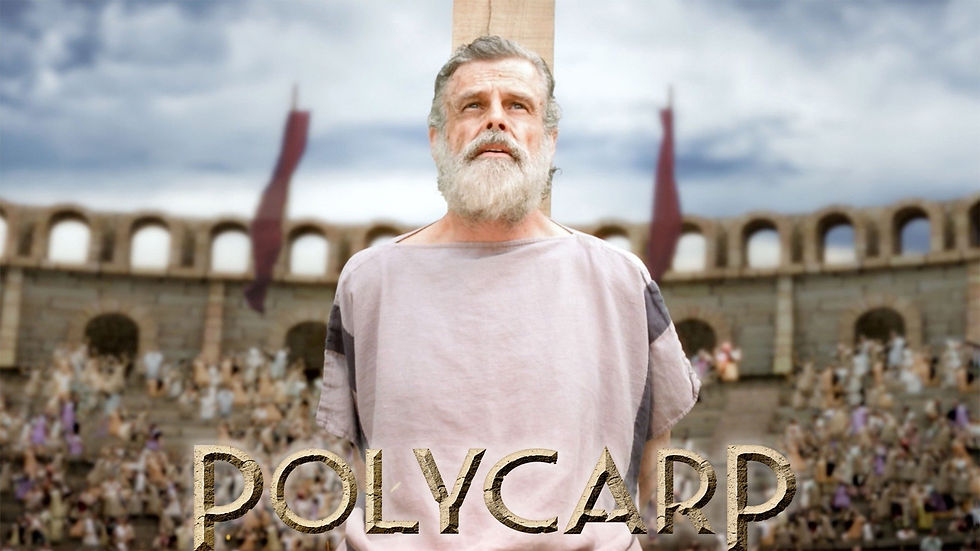
58. Polycarp on the Trinity (Part III)

Updated: 8 hours ago
Why Worship Jesus

In the last lesson we considered how Polycarp’s disciples professed their worship of Jesus, saying:
We worship this One who is the Son of God (Martyrdom of Polycarp 17:3)
Hopefully, you got a sense that their worship of Jesus was distinct from today’s heretical “Jesus Only” trend. But no worries if you haven’t perceived the difference yet because we’ll reinforce it today. We can sum it up this way: Polycarp himself wrote of “our Lord and God Jesus Christ” (Philippians 12:2) and the disciples of Polycarp worshipped Jesus because of their faith in the Father as the One God, and not in spite of it.
In other words, they believed in the Trinity. We hope you will incorporate the worship of Jesus into your own devotional life the same way they did, without confusion or ambiguity. We hope you worship Jesus the same way Christians did in the Early Church, that is, with an understanding of precisely what makes Jesus worthy of worship.

Completing Our Review
Remember how in the last lesson we read about the three wise men, the magi? They worshipped Jesus. And do you remember how God ordered that Jesus should be worshipped? Remember how both Mary Magdalene, the other Mary, and the Eleven Disciples worshipped him? That was because he’s the Son of God, the Messiah, and exalted by God. We worship Jesus because God made him worthy of worship.
Someone who believes in the Trinity starts with a basic belief in the One God our Father, but they don’t stop there. They progress to the second tenet of Trinitarian theology: The Father transmits his divine nature. He has shared it with Jesus. That was the theme of the last lesson, #57. Review it if you need to.
Today we’ll examine how God transmitted the divine nature to the Holy Spirit too. With that, our study on how Polycarp affirmed the second tenet of Trinitarianism will be complete. But, first we need to double down on what God did in Jesus, according to Polycarp, the Apostles, and Jesus himself.

The Reason to Worship
The Apostles worshipped Jesus for the right reason. Observing his authority as God’s Son, the Apostles bowed down before Jesus. The Bible tells us about a time when they saw Jesus still the sea, and it says:
… those who were in the boat worshiped him, saying, ‘You are certainly God’s Son’ (Matthew 14:33).
That’s also our reason for worshipping Jesus. The same reason why the Apostles and Polycarp worshipped Jesus—because he is the Son of God—is why we worship Jesus. Since the Son receives from the Father all things, including glory and the fullness of deity, it’s only right to worship him.

But get this: Only if you worship Jesus for this reason will he accept your worship. Jesus is not happy when people flatter him and forget the Father. That's why he said:
Why do you call me good? No one is good except God alone (Mark 10:18; Luke 18:19)
Agreement With Jesus and the Apostles
Didn’t Jesus himself tell us about how he was empowered, authorized, and glorified by the Father? Sure he did. He said this:
All things have been handed over to me by my Father (Matthew 11:27).
And he said:
I live because of the Father (John 6:56–57)

Furthermore, the Apostles acknowledged that the Father granted the divine nature to Jesus, saying:
… in him [Jesus] all the fullness of deity dwells in bodily form (Colossians 2:9).
Can you say the same thing the Bible says? Can you say of Jesus that all the fullness of deity dwells in him? In other words, do you recognize the special nature God has put in Jesus, the divine nature?
Glory, Glory, Glory
Well, that fullness of the divine nature is also called “glory,” and Jesus has always gotten it from the Father. He got it from the Father in his Resurrection, but he also got it before the World was ever created. He mentioned this pre-Creation experience in a prayer to the Father when he spoke of:
The glory which you have given me… [and] my glory which you have given me, for you loved me before the foundation of the World (John 17:21,24).

And what of Jesus’ explicit statement that God gave him all authority in Heaven and on Earth? You’ll remember he mentioned it when he issued the Great Commission, like this:
All authority in Heaven and on Earth has been given to me… (Matthew 28:19)
"Given" means someone gave it to him. And it's obvious who the Giver is. But, do you acknowledge before others that the Father gave all authority to Jesus, or do you not do that? It takes courage.
Certainly you recognize that Jesus didn’t get this authority from the Devil. Jesus resisted that temptation. If he had accepted the Devil's offer, Jesus would have owed service to the Devil. But, as it is, the Lord Jesus got all authority from his Father. Therefore today he serves the Father.

The Father: Source of the Divine Nature
Let’s look at the Trinity from Polycarp’s angle. In his epistle he put great emphasis on how the Father raised Jesus from the Dead. We hope you’ll agree without hesitation that this is a fundamental Bible truth. The New Testament asserts no less than 35 times that the Father raised Jesus from the Dead. Would anyone dare to disagree?
Just like the Apostles who emphasized it again and again, Polycarp viewed Christ’s Resurrection as an event packed with meaning. For example, Polycarp understood Christ’s Resurrection to mean: 1) God freed Jesus from Death, 2) God gave the divine nature to Jesus, and that 3) God authorized Jesus to be our God.
Regarding the first point, Polycarp spoke of:
… our Lord Jesus Christ… whom God raised up, having loosed the birth pangs of Hades (Philippians 1:2).

So with this statement Polycarp highlights how agonizing it was for Jesus to have been in Hades. Almost no pastors preach on this, consequently, practically no Christians are aware that Hades exists. But it does exist. In fact, it awaits you and me and it's only a heartbeat away.
Our consolation is that Jesus, who spent three days there, now has its keys!
God Gave Jesus Glory
Regarding points 2 and 3, Polycarp also taught that God gave Jesus glory. He encouraged his hearers to believe in the One God and Father as the Source of Jesus' glory and power. Polycarp encouraged Christians to trust in the One God by writing about:
… believing in the One who raised our Lord Jesus Christ from the Dead and gave him glory and a throne at his right hand (Philippians 2:1).

That Jesus got his glory from God shouldn’t be a surprise to us because Jesus spoke of it. In his prayers, he spoke directly to God about the glory God gave him. Remember what he said to the Father in his Upper Room prayer? Although we just read it a moment ago, it’s worth reinforcing. Here it is:
Father, I desire that they also, whom you have given me, be with me where I am, so that they may see my glory which you have given me, for you loved me before the foundation of the World (John 17:24).
The Love of God
So, we have identified the source of Christ’s glory. We hope that you don’t feel like this is too theological because it is not. It's no academic matter. It’s about the love of God. Our knowledge of how he loves is extremely practical because what God did in Jesus, he will do in us.

Jesus knew this, which is why he said:
The glory which you [the Father] have given me I also have given to them [the disciples]… (John 17:22).
And Polycarp knew it too. That’s why he wrote:
… the One who raised him [Jesus] from the Dead will raise us also if we do his will… (Philippians 2:2)

Practical Benefits
Wow. God will raise us also... if we do his will. That’s why this topic is so practical. Do you want to get what Jesus got? Do you want the divine nature? Do you want to be a beneficiary of God’s grace? Then do his will. Jesus’ resurrection is for you and me. It’s to benefit each of us.
God resurrected Jesus for our sake. We are the beneficiaries. Polycarp understood this well, which is why he called Jesus:
… the One who died on our behalf and was raised by God for our sakes (Philippians 9:2).

Do you get it? He said “for our sakes.” God gave Jesus the divine nature for your sake and mine. How so? Because of the access we now have to God in Christ, we’ll get glory and a divine nature too. We learn this magnificent teaching from Polycarp, and not exclusively from Jesus and the Apostles.
The Holy Spirit
Now, you might wonder “What about God transmitting the divine nature to the Holy Spirit?” Did Polycarp talk about that too? Interestingly enough, in his one epistle, he didn’t.
Regarding the origin of the Holy Spirit’s divine nature we get no statement from Polycarp. Although you might be tempted to consider this a weakness in Polycarp, as if he wasn’t very “developed” in his theology, it’s not a weakness. It’s a strength. To speak mostly of the Father and the Son aligns perfectly with the style of the Apostles. It’s a mature approach.

On the contrary, unceasingly reciting a Trinitarian formula is a sign of immaturity. For example, constantly repeating “in the name of the Father, and of the Son, and of the Holy Spirit” or using the sign of the Cross is not an indication of depth of knowledge of God. We believe in the Three, but we don’t cling superstitiously to a gesture or a "catch phrase."
We mostly prove our Trinitarian faith through our lifestyle, actually. The fruit of sound hermeneutics is righteousness. We demonstrate our faith in the Trinity by obeying the will of the Father according to the example of Jesus in the power of the Holy Spirit. The unity of the Three and not some mystical formula for prayer, is what produces in us consistent love and holiness. Call that "Trinity stability," if you like.
God Works Through the Spirit
The Church doesn’t consist of theologians. It consists of the righteous. When a righteous man like Polycarp explains God and Jesus in such a way that the Father-Son relationship inspires us, we can call him a good theologian. But when Polycarp proclaimed his Trinitarian faith with his blood, that’s when he earned the title of martyr.

When a man lives and dies like Polycarp, there’s no need for a long-winded speech about the Holy Spirit. Polycarp gave abundant evidence that the Spirit was within him. And, get this you who believe in the Trinity: That blessed presence of the Spirit in Polycarp was the very presence of Jesus and the Father.
A true Trinitarian believes in Jesus’ words when he said:
If anyone loves me, he will keep my word; and my Father will love him, and we will come to him and make our abode with him (John 14:23).

Practical Application
How do Jesus and the Father come to us and live within us if not through the Holy Spirit? And this experience, the experience of the Spirit proceeding from the Father and coming to us, is the second tenet of Trinitarianism. It’s what we mean when we say that God transmits the divine nature to the Spirit.
So, we've established that the Spirit gets his power, nature, and authority from God. That’s theology. But theology won't suffice. It must always become a lived experience. It did in Polycarp, and it must in us as well.
The practical application of your faith in the Trinity is that the Spirit will come from God with divine power and live in you. If it’s so with you, then like Polycarp, even if you suffer the flames of persecution, you will stand firm in the Father and the Son.

Trinity Promises From Jesus
The Father and the Son live in us through the presence of the Holy Spirit--who, we know, has been empowered, authorized, and sent by the One God, our Father. But he doesn't come independently. He comes to us under orders from the Father at the beckoning of Jesus, who said:
... the Helper, the Holy Spirit, whom the Father will send in my name, he will teach you all things, and remind you of all that I said to you (John 14:26).
Do you see the Trinity at work? The Father sends, the Spirit comes, and reminds us of Jesus. Here's one last passage to reinforce your faith in the Trinity. A little later, Jesus said:
When the Helper comes, whom I will send to you from the Father, that is the Spirit of Truth who proceeds from the Father, he will testify about me (John 15:26).

We believe!

Comments