
59. Polycarp on the Trinity (Part IV)

A Time of Sound Doctrine
Polycarp is easily one of the most famous men in Christian history. In any non-biased list that gauges opinion over the past 2000 years, he’ll show up right after the Apostles Paul, Peter, and John. With such fame, it’s astounding that we only retain one of his letters.

We also have an eye witness history of Polycarp’s martyrdom, a letter the Church father Ignatius directed to him, and comments by other Church fathers, like Irenaeus, highlighting Polycarp’s stellar reputation. It’s also by means of these texts that Polycarp’s testimony has been emblazoned on the hearts and minds of believers since the earliest generations of Christianity.
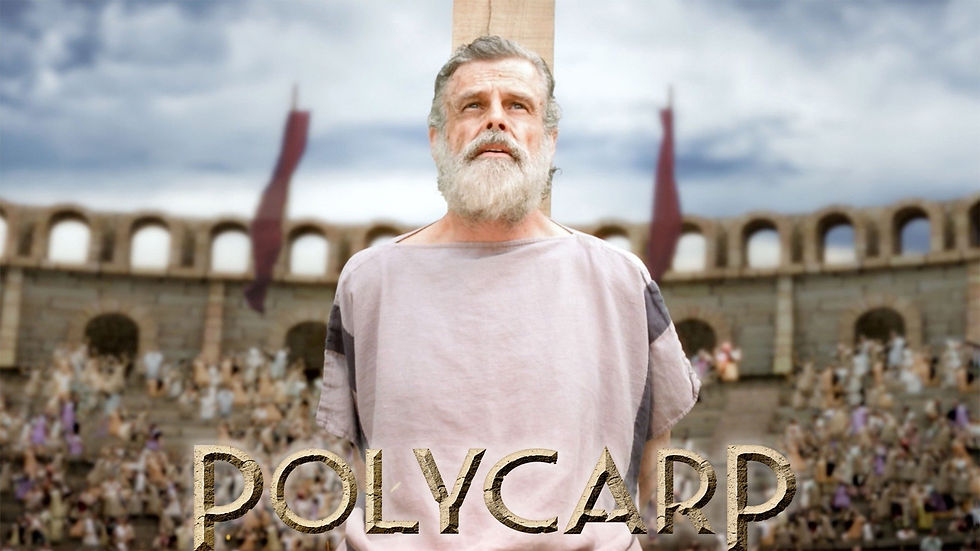
But, why has Polycarp become so inspirational? The answer is not just that he was a disciple of the Apostle John. And it’s not just that he was burnt at the stake in the Coliseum in Rome—a most memorable martyrdom. Primarily it’s because Polycarp bridged the gap between the Apostles and the generations of faithful Christians that followed.
Polycarp transmitted the Faith of the Apostles with simplicity. He had no theological system, just similarity to the Apostles. His testimony made it so that the truth he taught with such simplicity would steer Christian theology towards what we call today Trinitarianism.

Dying Words
Polycarp clung to a Biblical faith in the Father, Son, and Holy Spirit unto his dying breath. His followers record his final words, spoken in prayer, as these:
O Lord God Almighty, Father of your beloved and blessed Son, Jesus Christ… your Christ… in the incorruptibility of the Holy Spirit… you who are the undeceiving and True God… I praise you… through… Jesus Christ, your beloved Son, through whom be glory to you, with him and the Holy Spirit… (Martyrdom 14:1-2)
A beautiful prayer handed down to us. And the Church of Polycarp’s day became an example of this same doctrinal purity. They were known for their bold witness, simplicity, and sound doctrine.
But what’s left of that doctrine? If any of those ancient Christians were to visit a Christian congregation today, what would they think? The religion they observed would be unrecognizable because today’s pastors are nothing like the Church fathers. They brag about how they have become rich (Zechariah 11:5) and instead of offering themselves to God as a sacrifice, they sacrifice the flock to the god of commercialism. They commercialize the faith and turn their churches into a business.

Bad to Worse
The trend Paul foresaw of pastors going from bad to worse (2 Timothy 3:13) has reached such an extreme that modern congregations don’t have a clue about basic Truths. Most church goers don’t know who God is or whether baptism is necessary. They are clueless regarding the Kingdom and know nothing of the Resurrection. It’s patently plain that they do not tolerate sound doctrine (2 Timothy 4:3).
Contrast the modern Church with the Church of Polycarp’s day. They were busy laying the foundation of sound doctrine with a spotless testimony. With men like Polycarp as their pastors, they reinforced the tenets of Trinitarian faith: 1. that there is One God, the Father, and 2. that God transmitted the divine nature to Jesus and the Holy Spirit.
We’ve already examined Polycarp’s disciples’ affirmation of these first two tenets in our previous lessons. So, today we will examine their adherence to the last two tenets of Trinitarian faith: 3. that there is a hierarchy in the Trinity, and 4. that the Three operate with a division of labor. Let’s get to it!

The Hierarchy: Father, Son, and Holy Spirit
The God of Jesus
Although he didn’t factor in the Holy Spirit, Polycarp was clear regarding the order in the relationship between the Father and Jesus. You’ll notice how (in the passage below) he distinguishes the Father from Jesus by calling the Father “the God… of our Lord Jesus” and how Jesus is our “High Priest” and the “Son of God.” He wrote:
Now may the God and Father of our Lord Jesus Christ, and the Eternal High Priest Himself, Jesus Christ the Son of God, build you up in faith and truth… (Philippians 12:2)
Paul also used this same expression. For example, he said:
Blessed be the God and Father of our Lord Jesus Christ, the Father of Mercies and God of all Comfort (2 Corinthians 1:3).
The God and Father of the Lord Jesus, who is to be praised forever, knows that I am not lying (2 Corinthians 11:31).
Blessed be the God and Father of our Lord Jesus Christ, who has blessed us with every spiritual blessing in the heavenly places in Christ (Ephesians 1:3).

Jesus at God’s Right Hand
Polycarp also, like the Apostles, noted that God gave Jesus a throne at his right hand.
Wherefore, girding up your loins, serve God in fear and truth… believing on Him who raised up our Lord Jesus Christ from the Dead and gave him glory and a throne at his right hand… (Philippians 2:1)
Does that sound like hierarchy? It sure does to us. And thirteen times the Apostles mention the heavenly throne of Jesus. Here are two of them to refresh your memory:
So then, when the Lord Jesus had spoken to them, he was received up into Heaven and sat down at the right hand of God (Mark 16:19).
Jesus Christ… is at the right hand of God, having gone into Heaven, after angels and authorities and powers had been subjected to him (1 Peter 3:22).

Applying the principle of hierarchy to the Church community, Polycarp encouraged obedience to the elders and deacons. In other words, he promoted ordered relationships among believers based upon their submission to God and Christ. He said:
…be obedient to the presbyters and deacons as to God and Christ (Philippians 5:3).
A Word of Praise
As evidence that the Trinity’s order of relationships was central to their thinking, consider the final farewell of the story we call the Martyrdom of Polycarp. The author of the text, a believer named Pionius, expresses his desire to enter into the Kingdom of God. He says:
… that the Lord Jesus Christ may also gather me with his elect into his Heavenly Kingdom—to whom be glory with the Father and the Holy Spirit… (Martyrdom 22:3b)

This is but one more passage that demonstrates the care ancient believers put into keeping the Trinity hierarchy in their thoughts. The Trinity was ever before them. How different this sounds from modern praise!
Operational Division of Labor
Let’s go on to the final tenet of Trinitarianism: the operational division of labor. Polycarp consistently wrote of the ordered working of Father and Son in his writings. For example, according to him, we are saved by the will of God through Jesus. This is what he wrote:
… by grace you have been saved, not because of works, but by the will of God through Jesus Christ (Philippians 1:3).

In other words, God executes his will by means of his Son. So, the Father operates through Jesus. And Jesus came to us to give us a knowledge of the One God. That was his job, and Jesus did it well. Polycarp thought so, and he prayed the day of his martyrdom with these words:
O Lord God Almighty, the Father of your beloved and blessed Son Jesus Christ, by whom we have received the knowledge of you, the God of angels… (Martyrdom of Polycarp 14:1)
Effective for Salvation
Among Polycarp’s followers’ statements is one about our salvation. Hear it and consider the divine division of labor. These Christians were sure that God would bring us into the Kingdom through Jesus. They gave God glory for fulfilling our salvation through Jesus. Listen closely to how they used the word through in this doxology:
Now to the One who is able to bring us all by his grace and bounty into his eternal Kingdom, through his only-begotten Son Jesus Christ, be glory, honor, power, and majesty forever… (Martyrdom of Polycarp 20:2)

Nice. Do you notice how this sounds a lot like something straight out of the apostolic era? It does. The Apostles also affirmed that God works through Jesus. For example, the Apostle Jude provides us with a Scripture passage that sounds similar to Polycarp’s disciples’ doxology. Jude wrote:
Now to the One who is able to keep you from stumbling, and to make you stand in the presence of his glory blameless with great joy, to the Only God our Savior, through Jesus Christ our Lord, be glory, majesty, dominion and authority, before all time and now and forever. Amen (Jude 1:24–25).
Very similar.

Salvation Teamwork
But let’s wrap it up with Polycarp’s disciple’s farewell. In it, they define the work of salvation as being tethered to the Trinity. They are quick to acknowledge that Jesus is for the Father’s glory. And they include the Holy Spirit in the formula too. He’s no token addition to the list. Ready for the passage? It contains language with the unmistakable marks of early apostolic Christianity:
We bid you farewell, brethren, as you walk according to the word of the Gospel of Jesus Christ—with whom be glory to God, even the Father, and the Holy Spirit, for the salvation of his holy elect (Martyrdom 22:1).
With that, we have completed our study of Polycarp. If you take nothing else away from what we’ve examined, take this: The Early Christian Church saw salvation as teamwork--a teamwork in which Jesus and the Spirit make God’s scheme work. Do you see it that way? Do you see the Trinity as a Team like Polycarp did? We hope so!



Comments